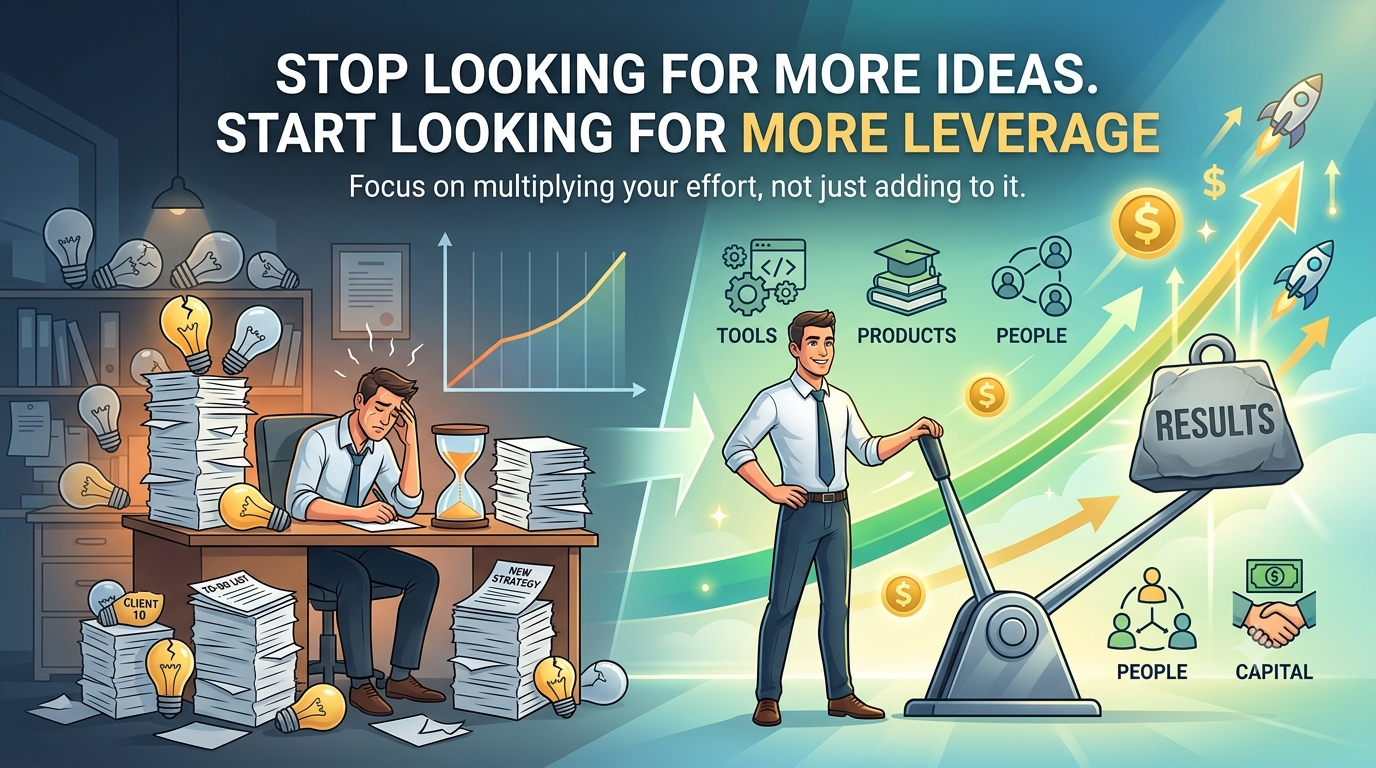
Stop Looking for More Ideas. Start Looking for More Leverage
Key Takeaways
- Leverage, not more ideas, harder work, or longer hours, is the real multiplier behind every productive entrepreneur.
- There are four distinct types of leverage: tools, products, people, and capital, and each one compounds differently.
- Most entrepreneurs stay stuck in linear thinking, where every extra result requires an equal amount of extra effort.
- The Leverage Ladder is a six-rung framework that shows you exactly how to scale from raw effort to compounding results.
- Finding your first lever is simpler than you think, and the right starting point depends on where you already create the most value.
Most entrepreneurs don't have an ideas problem. They have a leverage problem.
There's a reason some founders build empires while others stay buried in to-do lists despite working just as hard. It's not talent. It's not timing. It's leverage. Understanding how to build and use leverage is one of the most practical frameworks available to entrepreneurs today, and yet most people never learn it in any structured way.
More Ideas Won't Save You. More Leverage Will
The productivity advice most entrepreneurs follow is broken at the root. Wake up earlier. Use a better app. Batch your tasks. These tactics are fine at the margins, but they don't move the needle on their own because they're all optimizing effort, not multiplying it.
Why the "ideas first" mindset keeps you stuck
The "ideas first" mindset treats every new problem as a new opportunity for a new solution. More revenue? New product idea. More output? New productivity system. More growth? New strategy meeting. The result is a constant cycle of starting over, where energy gets scattered instead of compounded.
Ideas are inputs. Leverage is what turns inputs into outsized outputs. Without leverage, every new idea just adds more weight to an already full plate.
What leverage actually means in plain terms
Leverage, in its simplest form, is getting more output per unit of input. Eric Jorgenson, author of The Almanack of Naval Ravikant, describes it this way: your rate of learning and output should always be increasing relative to the effort you put in. As your career progresses, each unit of work you do should generate more results, not the same amount.
Think back to using a lever as a kid. A small force applied at the right point moves something far heavier than you could lift alone. Business leverage works in exactly the same way. You find the right point, apply your effort there, and the system does the rest of the work.
The compounding difference between effort and leverage
Here's where it gets real. An entrepreneur who relies purely on effort trades time for results in a one-to-one ratio. One hour in, one unit of output out. But an entrepreneur who builds leverage breaks that ratio entirely. A single well-built system, product, or team can generate results while they sleep, travel, or focus on the next opportunity.
The gap between these two approaches doesn't stay small. It compounds, and over years, it becomes the difference between owning a business and being owned by one.
The Four Types of Leverage You Can Use Right Now
Leverage isn't one-size-fits-all. There are four distinct categories, and each one works differently depending on where you are in building your business. Most entrepreneurs have access to at least two of them right now, today, without any new investment.
1. Tool Leverage: Let Technology Do the Heavy Lifting
Tools were the first form of leverage humans ever created. In a business context, tool leverage means using software, automation, and systems to handle tasks that would otherwise eat your time. A CRM that automatically follows up with leads. A scheduler that eliminates back-and-forth emails. An AI writing assistant that drafts first versions of content. Each one multiplies what a single person can accomplish in a day. The key is being ruthlessly selective: the best tools eliminate entire categories of work, not just individual tasks.
2. Product Leverage: Build Once, Earn Repeatedly
Product leverage is what happens when something you build continues delivering value long after the initial work is done. A course, a book, a piece of software, a templated service: these are all examples of product leverage. You invest effort once, and the output keeps paying returns.
This is also why content marketing is so powerful for entrepreneurs. A single high-quality article, video, or framework can attract leads, build authority, and generate revenue for years. The work is front-loaded, but the return is ongoing.
3. People Leverage: Multiply Your Output Through Others
People leverage means building a team, a network, or a community that carries work you can't, or shouldn't, be doing yourself. This isn't about delegation for its own sake. It's about recognizing that the ceiling on what any one person can build alone is very low, and the fastest way through that ceiling is having the right people operating alongside you.
The distinction worth noting here is that people leverage works best when you empower proven operators as partners, not just give tasks to employees. People who own outcomes generate leverage. People who just complete tasks generate output.
4. Capital Leverage: Put Money to Work Instead of Time
Capital leverage is using financial resources, whether that's your own profits, credit, or investment, to acquire results faster than you could produce them through effort alone. Wayne Huizenga, who built multiple billion-dollar companies across industries, used capital leverage as a core strategy: using stock and credit to buy faster than rivals could react, while keeping proven operators as partners rather than employees.
Capital leverage is typically the last type of leverage entrepreneurs build, and for good reason. It works best when it's accelerating something that already has proof. Pouring capital into a broken model just breaks it faster.
Why Most People Never Build Leverage
The frustrating truth is that leverage isn't hidden or complicated. The reason most entrepreneurs never build it comes down to two deeply ingrained thinking patterns that feel completely rational, right up until they cost you everything.
Linear thinking keeps effort tied to output
Linear thinking is the default setting for most high-achievers. Work harder, get more done. Put in more hours, see more results. It works early on, which is exactly why it's so hard to break. But linear thinking has a hard ceiling, and most entrepreneurs hit it around the time their business starts gaining real traction. Suddenly, every new result requires a proportional increase in personal effort, and there are only so many hours available.
The shift from linear to leveraged thinking isn't about working less. It's about redirecting effort toward things that multiply, not just add.
Small opportunities feel safer but cost you more long-term
The second trap is playing small because it feels manageable. Taking on one more client instead of building a system that serves ten. Answering every customer email personally instead of creating a help center that answers the top twenty questions automatically. These choices feel responsible in the moment, but each one is a quiet vote against building leverage.
Over time, choosing the safe, small path compounds in the wrong direction. The gap between where you are and where leveraged thinking could have taken you grows wider every year, not because you weren't working hard enough, but because the effort wasn't being multiplied.
How to Find Your First Lever
Audit what you already do well
Start with an honest inventory of your current skills and activities. What do you do that other people find genuinely difficult? Where do you consistently create value that others struggle to replicate? These are the raw materials of leverage. The best first lever is almost always built on top of something you already do well, not something brand new you have to learn from scratch.
Spot where one action creates multiple results
Look at your current workflow and ask: where does one input produce more than one output? A single podcast interview that gets repurposed into a blog post, a social clip, an email newsletter, and a lead magnet is a leverage point. A sales call framework that can be trained to a new hire and used indefinitely is a leverage point. These moments already exist in most businesses. They just haven't been intentionally built out and repeated.
Start with tool or people leverage before capital
If you're early in the process of building leverage, start with tools and people, not capital. Tool leverage is the fastest to implement and the lowest risk. A well-chosen automation or piece of software can free up hours per week within days of being set up. People leverage takes longer to build correctly, but it scales further.
Capital leverage comes last, not because it isn't powerful, but because it amplifies whatever is already working. Build the system first. Prove it works. Then use capital to pour fuel on the fire.
The Leverage Ladder: A Step-by-Step Path to Scale
The Leverage Ladder is a practical six-rung framework that maps the journey from raw effort to compounding results. Each rung builds on the one below it. Skip one, and the ladder becomes unstable. Most entrepreneurs who feel stuck have simply skipped a rung without realizing it.
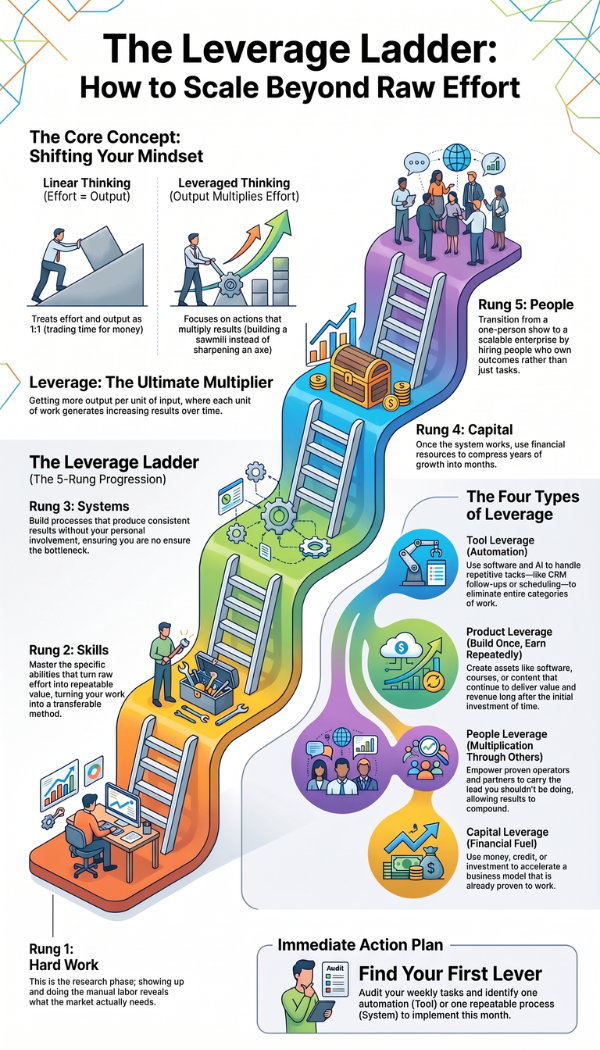
Rung 1: Hard work reveals what the market actually needs
Every leverage story starts the same way: with someone showing up and doing the work before any systems exist. This isn't glamorous, but it's non-negotiable. Hard work at the start isn't the goal, it's the research phase. It shows you what customers actually want, what problems are worth solving, and where the real opportunities hide. Without this foundation, any leverage you try to build sits on guesswork.
Rung 2: Skills turn effort into repeatable value
Once you know what the market needs, the next step is getting genuinely good at delivering it. Skills are the bridge between raw effort and leverage. A skilled entrepreneur doesn't just solve a problem once. They develop a method that can be repeated, refined, and eventually systematized or taught.
- Identify the two or three core skills that generate the most value in your business right now.
- Invest deliberately in sharpening those specific skills, not broad self-improvement.
- Document how you apply those skills so the process becomes transferable.
- Look for the intersection of multiple skill sets. Leverage often lives at the crossover point between two fields most people treat separately.
The goal at this rung isn't mastery for its own sake. It's building a repeatable method that can eventually run without your constant involvement. That documentation habit, writing down how you do what you do, is often the moment the leverage ladder starts to feel real.
Skills also build what Eric Jorgenson describes as your rate of value creation. As your career or business progresses, the same hour of skilled work should generate more output than it did a year ago. If that ratio isn't improving, the skill development isn't being applied toward leverage. It's just making you more efficient at staying busy.
Push through Rung 2 with patience. Entrepreneurs who rush past the skills stage tend to build systems around mediocre methods and wonder why the system doesn't scale. The method has to work first. Then you build the machine around it.
Rung 3: Systems let work happen without you
A system is any process that produces consistent results without requiring your personal involvement every time it runs. This is the rung where leverage starts to feel real. When your onboarding process runs automatically, when your content pipeline produces output on a schedule, when your sales process follows a repeatable framework your team executes without you, that's a system working. The goal isn't to remove yourself entirely. It's to stop being the bottleneck.
Rung 4: Capital accelerates what already works
Capital leverage is the accelerant, not the foundation. Once you have a proven system generating consistent results, capital can compress years of growth into months. This is where reinvesting profits, using credit strategically, or bringing on investment starts to make sense. Before that point, capital just speeds up whatever is already happening, including the mistakes.
Wayne Huizenga's playbook illustrates this perfectly. He didn't use capital to figure out his model. He used it to scale a model he'd already validated. The capital followed the proof, not the other way around. That sequencing is everything.
Rung 5: People carry the load so results compound
The highest-leverage move most entrepreneurs make is building the right team. Not just hiring help, but finding and empowering people who own outcomes, not just tasks. When the right people are in the right roles, with clear accountability and genuine authority, your results compound in ways that no tool, system, or capital injection can match alone. This is the rung where businesses stop being one-person shows and start becoming scalable enterprises.
Stop Chasing the Next Idea. Here Is What to Do Instead
The most productive thing you can do right now is not brainstorm a new idea. It's to look at what's already working and ask: where is the lever I haven't pulled yet? Every entrepreneur has at least one: a skill that could become a product, a process that could become a system, a relationship that could become a partnership. The raw material for your next level of productivity is almost certainly already in your hands.
Pick your first rung this month. Audit your skills. Map one system. Identify one tool that eliminates an entire category of repetitive work. The shift from effort-based thinking to leverage-based thinking doesn't happen in one decision. It happens in one small, deliberate action repeated consistently. The compounding takes care of the rest.
Frequently Asked Questions
Below are the most common questions entrepreneurs ask when they first start thinking seriously about building leverage into their work and business.
What is personal leverage and why does it matter?
Personal leverage is your ability to generate more output per unit of effort by using tools, systems, skills, people, or capital strategically. It matters because without it, your income, impact, and freedom are all capped by the number of hours you personally have available. Building personal leverage is what separates entrepreneurs who scale from those who stay stuck trading time for money indefinitely.
What is the easiest type of leverage to build first?
Tool leverage is almost always the fastest and lowest-risk starting point. The right software or automation can free up meaningful time within days of being implemented, requires no hiring, and often costs very little relative to the value it returns.
Start by identifying the three tasks you do most repeatedly each week that don't require your unique judgment or expertise. There is almost certainly a tool, a scheduling app, a CRM automation, a template system, an AI assistant, that can handle a significant portion of that work for you immediately. That recovered time is your first lever in action.
Can leverage work in a regular job, not just a business?
Absolutely. Leverage applies anywhere output matters. An employee who builds a reporting template that saves the whole team two hours a week has created tool leverage. Someone who develops a reputation as the go-to expert in a specific niche inside their company has built personal brand leverage. A professional who mentors junior colleagues effectively is using people leverage to expand their impact far beyond their own role.
The principles are identical whether you're an entrepreneur or an employee. The main difference is that employees often have fewer options for capital leverage, but tool, product, people, and skill leverage are all fully available and highly rewarded in career contexts.
How is leverage different from just working smarter?
"Working smarter" usually means optimizing effort: doing the same things more efficiently. Leverage is fundamentally different because it changes the ratio between input and output, not just the speed of the input. Working smarter might save you an hour. Building leverage can make a single hour produce ten times the result of a normal one.
Think of it this way: working smarter is sharpening the axe. Leverage is building a sawmill. Both are improvements, but only one of them scales without limit.
How long does it take to see results from building leverage?
Tool leverage can show results within days. Implement the right automation today and you may recover hours this week. People leverage typically takes longer, often several months of hiring, training, and establishing trust before the compounding effect becomes visible.
Product leverage sits in the middle. Building a course, a content library, or a repeatable service framework might take weeks or months of upfront work, but once it's live, the returns extend indefinitely. The effort curve inverts: heavy at the start, then increasingly passive over time.
The honest answer is that the timeline depends entirely on which rung of the leverage ladder you're building and how consistently you apply the work. Most entrepreneurs who commit to the process see meaningful shifts in their productivity and freedom within three to six months of focused effort.
A Final Thought
Before you look for another business idea, ask yourself this:
What if the fastest path to additional revenue isn't another idea at all, but a better understanding of the leverage you've already built?
Continue the Conversation
If that question made you curious, I think you'll enjoy exploring your own situation with the Opportunity Compass™.
It is a short, guided conversation designed to help entrepreneurs recognize what they already have to work with and discover practical ways to turn it into additional revenue.
At the end of the conversation, you'll receive your personalized Opportunity Diagnosis™, highlighting what stands out most in your situation and explaining why those opportunities naturally fit your goals.
But the real goal of the Opportunity Compass isn't simply to help you discover your next opportunity. It's to help you begin seeing opportunities the way experienced entrepreneurs do.